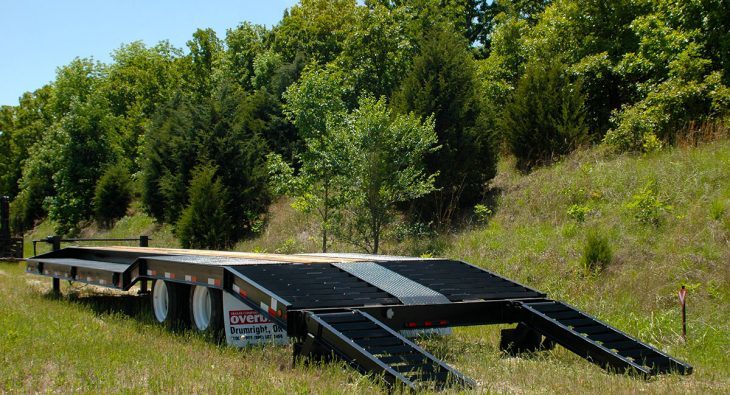
Trailer ramps are often referred to as
beaver tails—broad, strong additions to a trailer that lift and drop to load and unload your trailer. And clearly, a ramp is necessary to load a heavy vehicle or piece of machinery onto your trailer. But one size doesn’t fit all. You have options.
Overbilt offers three types of
trailer ramps you can choose from as we manufacture your trailer. Your ramp must be robust enough to withstand heavy wear and tear over time. Imagine loading a bulldozer onto your trailer with its cleats slowly rolling up the ramp. Or heaving your ramp on and off the trailer and letting it slam to the ground. Ramps take nothing short of a beating.
Here are the three types of trailer ramps we offer and details about why you might want to consider one over the others.
MANUAL TRAILER RAMPS
A typical
manual ramp is five feet long, with a five-foot extension. These are, as they suggest, raised and lowered by hand.
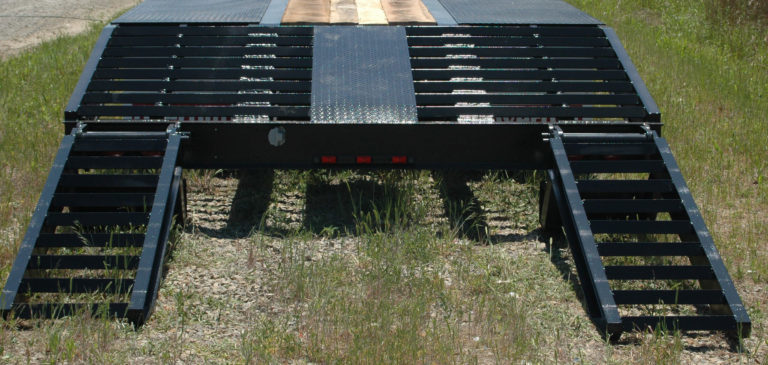
Overbilt builds a lightweight
manual ramp made of strong high-tensile steel. We use spring assists, heavy-duty torsion springs, which help bring the ramp off the ground to load back onto the trailer. The ramps are manufactured using a self-cleaning design, built with spaced angle iron, so muck falls through the ramp, rather than stacking up.
HYDRAULIC TRAILER RAMPS
A
hydraulic trailer ramp is for anyone who does not want to bother with a
manual ramp, or someone who needs to load a piece of equipment that requires a more gradual load angle on a longer trailer. For example, paving equipment that won’t drive up a steep ramp extension.
By placing a hydraulic cylinder between the ramp and the trailer, it allows for push-button movement of the ramp. Overbilt uses a
self-contained hydraulic system, with a side-mounted toolbox powered by a 12-volt battery. A hand-held remote that plugs into the toolbox allows you to lift or drop the ramp. You may also opt for a wireless push-button remote.
AIR-OPERATED TRAILER RAMPS
An air-operated trailer ramp is the same as the
hydraulic ramps, with one significant difference. The air-operated ramp utilizes the air-brake system that is already hooked up to your trailer. Overbilt technicians tap into this system to raise and lower the ramp.
DETERMINING WHICH RAMP TO CHOOSE
Manual ramp are the least expensive option and are cheaper to repair if the ramp becomes damaged. These are best if you are willing to do the work of lifting and dropping the ramp.
Hydraulic ramps are the most expensive option.The primary reason you would want a
hydraulic ramp is if you simply do not want to, or physically cannot move a manual ramp. Due to size, the ramp may also be too heavy to manually lift and would then require a hydraulic lift. For example, if you need a long ramp, choosing a manual option is not in your best interest. No matter how many springs you have, it is going to be too heavy to lift on your own. You’ll want a
hydraulic trailer ramp.
Air-operated ramps are a newer option and lower maintenance as you do not encounter hydraulic leaks or electrical problems with the pump. They have the same functionality as the hydraulic, and are less expensive. In the rare case that a ramp is extremely long and heavy, hydraulics can carry more weight than air-operated. Because air-operated functionality is newer, and many trailer owners have not used this system before, some prefer the familiarity of hydraulics, compared with trying something new.
If your company is concerned about safety and OSHA requirements, a hydraulic or air-operated ramp will help protect your staff from injuries. Just one button will raise or lower the ramp.
IS CUSTOMIZATION AVAILABLE?
Overbilt is a custom builder, so you have options available within each ramp category. Custom lengths and widths are determined by what you will be hauling. For hydraulic and air-operated ramps, you can choose between three ramp materials: steel plated, wood-filled, or self-cleaning, which uses spaced angle iron to allow debris to fall through the slats.
Contact Overbilt now so we can provide you with the highest quality
custom-built trailer and ramp you need.