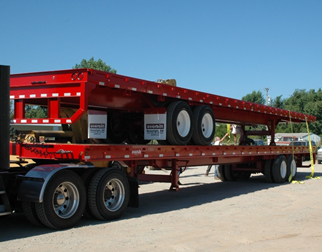
Tire Recommendations At Overbilt Trailer Company.
On a 7-10 Ton Lowboy Trailer, we typically recommend a 235/85R 16’s. These are 16-inch tires with an F load range carry capacity. The larger 15-25 Ton Tri-Axle Gooseneck Trailer our standard tire choice is a 215 75R 17.5’s with an H load range or 235 75R 17.5’s with a J load range. When building a 25 Ton Custom Trailer we choose the larger 255 70R 22.5 and the tires are rated load range J. We also use the 255 70R 22.5’s on 35 Ton Tilt Trailers and 50 Ton Float Trailers.
Information Printed On Tires Manufactured In The U.S.
Tire Size - is printed on the sidewalls of the tire. This is typically indicated as 215/75R or 235/75R or 255/70R or some variation of these numbers.
Maximum Load - capacity is indicated for both a single tire capacity of 4805 and dual tires capacity of 4840 on 215/75R tires. Load amounts vary depending on tire sizes, ply and load range. ST (Special Trailer) Tires typically carry more weight then passenger tires.
Inflation Pressure or PSI - (Pressure per square inch) is something that should be checked when the tire is cold. Use a good quality tire gauge when checking the pressure. PSI is indicated on the tire’s sidewall.
Tire Manufacturers Location - is a 4 digit code stamped on the tire telling you where the tire was manufactured.
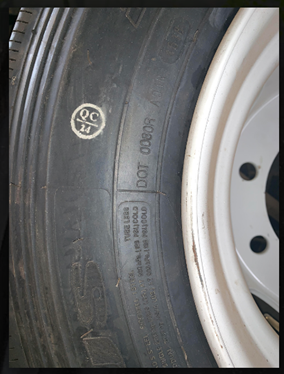 Tire Manufacturers Date in WWYY Format -
 is located just past the “DOT” stamp on the tire. You will see a series of 4 numbers that indicate the week and the year the tire was manufactured 0120 would be the first week of 2020. When it comes to Trailers this date can be put to good use especially if you are purchasing a used trailer.
Other Tire Related Items - Suggested miles per hour may or may not be found on your tire. Most passenger tires have this rating on them.
Registering Your Tires - online with the manufacturer is an important step in caring for your tires. The registrations will be used to notify you in the event of a tire safety recall.
General Trailer Tire Information
The sidewalls of ST (Special Trailer) tires are much stiffer than regular/passenger tires, the ST’s often contain more polyester and steel belts larger in diameter and the tire tread patterns are designed to deflect heat allowing the tire to run cooler. Most importantly ST rated tires are designed to carry the weight required for large equipment hauling trailers and assist with the elimination of sway while traveling down the highway.
Wear patterns on trailer tires - an over-inflated tire will wear the center tread eventually becoming smooth if ran over-inflated for long periods. An under-inflated tire will wear the outer walls of your tires. It is dangerous to run on an underinflated tire for a long time. Underinflation will increase the heat and friction on the tire putting you at risk for a blowout. You do not get full use of your tires when they are under or over-inflated. Tire inflation is important to the life of your tire and your bottom line.
Blowouts and tread separation for no apparent reason may be an indicator that the tire is old… you may want to check the manufacturer’s date found near the letters DOT on the tire. Tire replacement should be done in the 4th or 5th years regardless of the tread on the tire. One of the primary reasons ST Tire manufacturers are required to put a manufacture date on trailer tires is the possibility of a chemical breakdown, overtime UV Rays, exposure to the environment and road grime cause the tires to become brittle and or break down. Tread is not a good indicator of tire health. A tire that is 6 years or older is susceptible to blowouts it’s exposure to chemical breakdown has occurred and it is no longer a dependable tire.
Proper trailer tire care
Make sure you own a Quality Tire air gauge.
Always air your tires when the tires are cold.
Run with all tires inflated to the same PSI.
Do not exceed the recommended speed for the tires it puts you at risk of a tire blowout.
Wash your tires regularly to remove Road grime that can cause pre-mature breakdown of the tire.
When storing your trailer for a long period of time there are several things you should take into consideration to care for the tires. Lyft the trailer to take as much weight as possible off the tire. Move the trailer on a regular basis to eliminate flat spots on the trailer tires. Protect the tires from the suns damaging UV rays.