
Choosing your trailer
An Overview
Choose a lowboy when you’re hauling tall equipment, regularly cross under low bridges or power lines, or your loads are over 30,000 lb and need a low center of gravity for stability. Choose a flatbed when your loads are under the standard legal height limit, you need maximum deck length and flexibility, and load-and-unload speed matters more than the extra clearance a lowboy provides. Most heavy equipment haulers eventually need both — but if you can only own one, base the decision on the tallest piece of equipment you regularly move.
Clearance
The clearance problem is the real deciding factor
A tag-a-long connects to a standard hitch ball or pintle behind the truck’s rear axle. A gooseneck connects to a coupler mounted in the truck bed, directly over or just ahead of the rear axle. That single difference cascades into nearly every other property of the trailer.
Equipment height (on its tracks/wheels) 8’0"
Flatbed will it fit under 13’6"?
Yes
Lowboy will it fit?
Yes
Equipment height (on its tracks/wheels) 9’0"
Flatbed will it fit under 13’6"?
Marginal
Lowboy will it fit?
Yes
Equipment height (on its tracks/wheels) 9’0"
Flatbed will it fit under 13’6"?
No
Lowboy will it fit?
Yes
Equipment height (on its tracks/wheels) 11’0"
Flatbed will it fit under 13’6"?
No
Lowboy will it fit?
Yes (verify deck height)
Equipment height (on its tracks/wheels) 12’0"
Flatbed will it fit under 13’6"?
No
Lowboy will it fit?
Verify with permit route planning
If your equipment is 10 feet tall sitting on its own tracks, you cannot legally haul it on a standard flatbed. A lowboy is not optional.
stability & loading
Beyond clearance: stability and loading
stability
A lowboy keeps the load’s center of gravity closer to the road, which makes a difference in crosswind stability, off-camber jobsite movement, and emergency braking. For loads above 50,000 lb, the stability difference is meaningful — drivers report that the same load feels much more controlled on a lowboy than on a flatbed.
Loading
Loading is faster on a lowboy with a detachable gooseneck — you drop the gooseneck, drive the equipment straight onto the deck at near-ground level, and reconnect. Flatbeds require ramps, which are slower and steeper. For equipment with low ground clearance (some excavators, low-profile dozers), lowboy loading is the only practical option.
buying a flatbed
Where the flatbed wins
Flatbeds are cheaper at the same tonnage rating. They’re simpler — no hydraulic gooseneck, no dropped deck engineering. They give you a longer continuous flat surface, which is better for long beams, pipe, lumber, and equipment that doesn’t need clearance.
If you mostly haul under 30,000 lb and never anything taller than 9 feet on its own wheels, a flatbed gives you flexibility and lower cost. If you swing into occasional taller loads, you can rent a lowboy for those jobs.
contractors errors
What contractors get wrong
Buying a flatbed because the price is right, then permanently renting lowboys for any tall equipment job. Within two or three years, the rental cost exceeds the difference you would have paid up front for a lowboy. If you’re moving tall equipment more than once a month, own the lowboy.
The other mistake is undersizing the lowboy’s tonnage to save money. A 30-ton lowboy with a 35,000 lb load on it is at the edge of its rating — you have no margin for road conditions, off-route weight inspection, or attachments. Spec the lowboy 25 to 30% above your heaviest expected load.
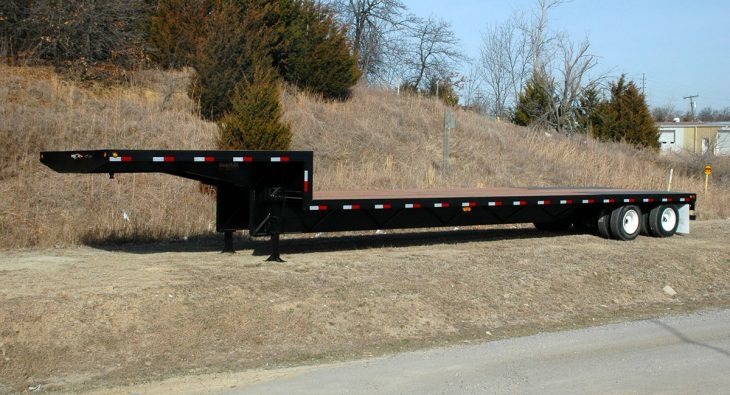
How Overbilt builds either one right
Every Overbilt trailer is built by a single craftsman from start to finish. We build flatbeds, lowboys, and detachable gooseneck lowboys from 30 ton through 150 ton ratings. Send us your typical load list — equipment make, model, and height — and we’ll tell you which deck style fits your work and spec it to your real requirements.
Toll-Free
(888) 687-2458Local
(918) 352-4474