
Choosing the right trailer
Choosing your Trailer Overview
The right trailer for your equipment is determined by three numbers: the operating weight of your heaviest machine, the gross vehicle weight rating (GVWR) you legally need, and the deck length required to fit the equipment with proper weight distribution. At Overbilt, we recommend selecting a trailer with a GVWR at least 20% above your heaviest expected load — this protects axles, brakes, and suspension components from premature wear and gives you headroom for attachments, fuel, and chains.
weight class
What weight class do I actually need?
Equipment manufacturers list operating weight, but that number rarely tells the whole story. You need to add the weight of any attachments, full fuel and hydraulic fluid, mounted tools, and any rigging that travels with the load. Once you have the real working weight, match it to a trailer class.
Skid steer with attachments
Real working weight
8,000 – 12,000 lb
Recommended trailer class
10 Ton tag-a-long
Mini excavator (8-ton)
Real working weight
17,000 – 20,000 lb
Recommended trailer class
15–20 Ton gooseneck
Mid-size excavator (20-ton)
Real working weight
45,000 – 52,000 lb
Recommended trailer class
30 Ton lowboy
Large dozer (D8-class)
Real working weight
85,000 – 95,000 lb
Recommended trailer class
50 Ton lowboy
Crane counterweights, transformers
Real working weight
100,000 – 250,000 lb
Recommended trailer class
75–150 Ton specialty lowboy
Width & Length
What about deck length and width?
Deck length should accommodate the equipment plus 12 to 24 inches of working room on each end for tie-down and ramp clearance. Width matters most for tracked equipment — tracks should sit fully on the deck, not overhang. Overhanging tracks concentrate load on the deck edge and damage the trailer over time.
Expensive Mistakes
What buyers commonly get wrong
The most expensive mistake we see is buying a trailer rated exactly to the equipment weight. Once you add a bucket, full fuel, a few chains, and the operator’s toolbox, you’re already over GVWR. The second mistake is undersizing axle count to save money — fewer axles means higher per-axle loading, which fails DOT scale checks and ages the trailer fast.
How Overbilt helps you spec it right
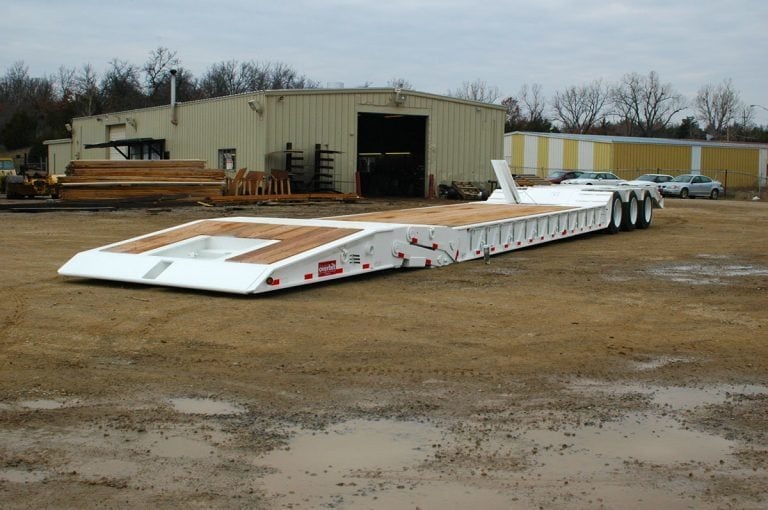
Every Overbilt trailer is built by a single craftsman from start to finish. When you send us your equipment list, we spec the trailer around your actual fleet — not a catalog standard. We’ve built configurations from 6 ton tag-a-longs through 150 ton specialty lowboys for oil and gas, utility, construction, and mobile power generation customers.
If you’re not sure what class you need, send us your equipment make, model, and any attachments you haul with it. We’ll tell you exactly what GVWR and deck configuration fits.
Toll-Free
(888) 687-2458Local
(918) 352-4474