
Overview
What Drives the Cost of a Custom Heavy Equipment Trailer
A custom heavy equipment trailer is priced around your specification — there is no catalog price tag. Tonnage rating is the biggest cost driver, followed by axle count and configuration, deck length, deck height (lowboys cost more than flatbeds at the same rating), and any hydraulic or electrical systems integrated into the build. Steel pricing also moves continuously, so a trailer that’s quoted today may cost differently next quarter. At Overbilt, every trailer is quoted against your spec and current material pricing the day you call.
Prices
Why we don’t publish prices online
Two reasons. First, every Overbilt trailer is built to spec — no two are identical, and a “30 ton lowboy” can range widely in cost depending on whether it has a hydraulic detachable gooseneck, air ride suspension, custom outriggers, or specialty deck configurations. Publishing a single number would be misleading. Second, steel and component pricing change frequently. A price published online would be out of date within months, and we’d rather quote you against today’s costs than yesterday’s.
Trailer Cost
What actually drives the cost of your trailer
Tonnage rating
The single biggest cost factor. Higher tonnage means heavier steel in the main beams, more axles, larger brakes, and beefier suspension components. Every step up in capacity adds cost roughly proportional to the structural increase.
Axle count and configuration
A two-axle trailer is dramatically less expensive than a four-axle build at the same rating. Air ride suspensions cost more than spring. Self-steering rear axles add cost up front but pay back in tire wear and turning ability over the life of the trailer.
Deck height
Lowboys cost more than flatbeds at the same tonnage because the dropped center deck and gooseneck connection require more engineering and fabrication. Hydraulic detachable goosenecks add cost again over fixed or removable mechanical goosenecks. If your equipment doesn’t need the clearance, a flatbed at the same tonnage will cost less.
Deck length
Beyond a certain point, longer decks require additional cross members and beam reinforcement. Cost per foot is not linear — a 30-foot deck is meaningfully more than 1.5 times the cost of a 20-foot deck at the same tonnage.
Custom features
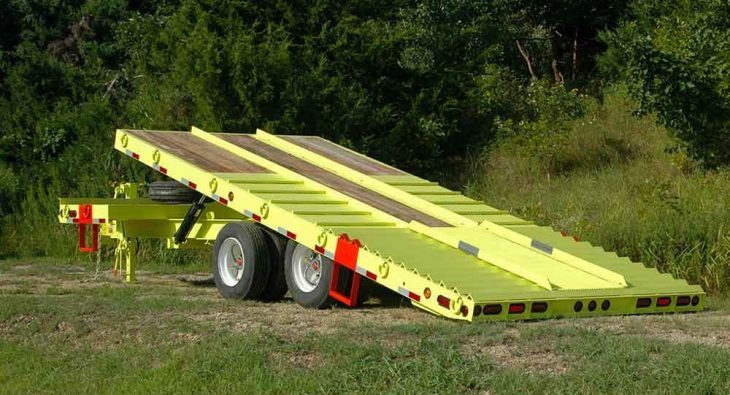
Hydraulic ramps, beavertails, outriggers, removable side rails, integrated tool boxes, custom paint, LED lighting packages, electrical hookups for equipment, winches — each one is a line item. Most don’t cost much individually; cumulatively they can move a quote significantly.
Price Factors
What buyers don’t always factor in
Lead time matters as much as price. A trailer that arrives six months late costs you in equipment downtime and lost contracts. Quality of fabrication matters even more — a poorly welded trailer will fail under load and cost you a truck, the equipment, and possibly a driver. Cheap up front becomes expensive on the highway.
The other factor buyers underweight: steel sourcing. Domestic steel costs more than imported, but it’s traceable and consistent. We use domestic steel on every Overbilt build for that reason. It’s part of the cost — and part of why our trailers last.
How Overbilt quotes
Every Overbilt trailer is built by a single craftsman from start to finish. There are no production lines to amortize, which means you pay for the trailer you actually need — not catalog SKUs with options bolted on. We’ve built configurations from 6 ton tag-a-longs through 150 ton specialty lowboys for oil and gas, utility, construction, mobile power generation, and specialty haulers across the United States.
Send us your equipment list, target deck length, and any custom requirements. We’ll quote your spec against current steel pricing and give you a real lead time — not a catalog ship date.
Toll-Free
(888) 687-2458Local
(918) 352-4474